
Healthcare · AI automation · Hospitals · Patient support · EHR
AI Automations in Hospitals: From After-Hours Calls to Production Workflows
Most hospital AI dies in a demo. Here is the practical map — patient support, scheduling, documentation, and claims — for putting automation into production without ripping out the EHR.
ABI Tech Editorial · Healthcare implementation team · September 13, 2026 · 11 min read

Every hospital we meet has an AI slide. Almost none have an AI system their night-shift nurses will actually use. The gap is not models. It is operations: which call types to take off the line, where the EHR remains the source of truth, and who owns the exception queue at 2 a.m.
This is a playbook for hospital operators — COOs, CIOs, patient-access leads, and medical directors — who need production automation in 2026, not another proof of concept. It is written from implementation work: after-hours patient support, document-heavy revenue cycle, and the unglamorous plumbing between a model and an EHR.
Why hospital AI stalls after the demo
Demos are trained on clean transcripts. Hospitals run on messy ones: a parent calling about a fever, a discharge instruction in two languages, a refill that is actually a prior-authorization problem. The model looks brilliant in a board recording and then refuses to book, or worse, books the wrong clinic.
Three patterns kill most programs:
- Starting with diagnosis or treatment advice. Regulators, counsel, and clinicians will (correctly) stop you. Start with access, status, and paperwork.
- Treating the EHR as optional. If the bot cannot read slots, write a note, or hand off a ticket, it is a toy.
- No owner for exceptions. Automation without a named queue is how patients get stuck in a loop at midnight.
ABI Tech’s healthcare work sits in that gap — the same gap we closed in an AI-powered patient support system that cut wait time and support cost without replacing the hospital’s record system. Read the patient-support case study if you want the numbers; this article is the operating manual behind them.
Five hospital automations that actually pay
Rank work by volume × delay × how reversible a mistake is. High volume, high delay, reversible: automate first. Low volume, irreversible, clinical: do not.
1. After-hours patient support
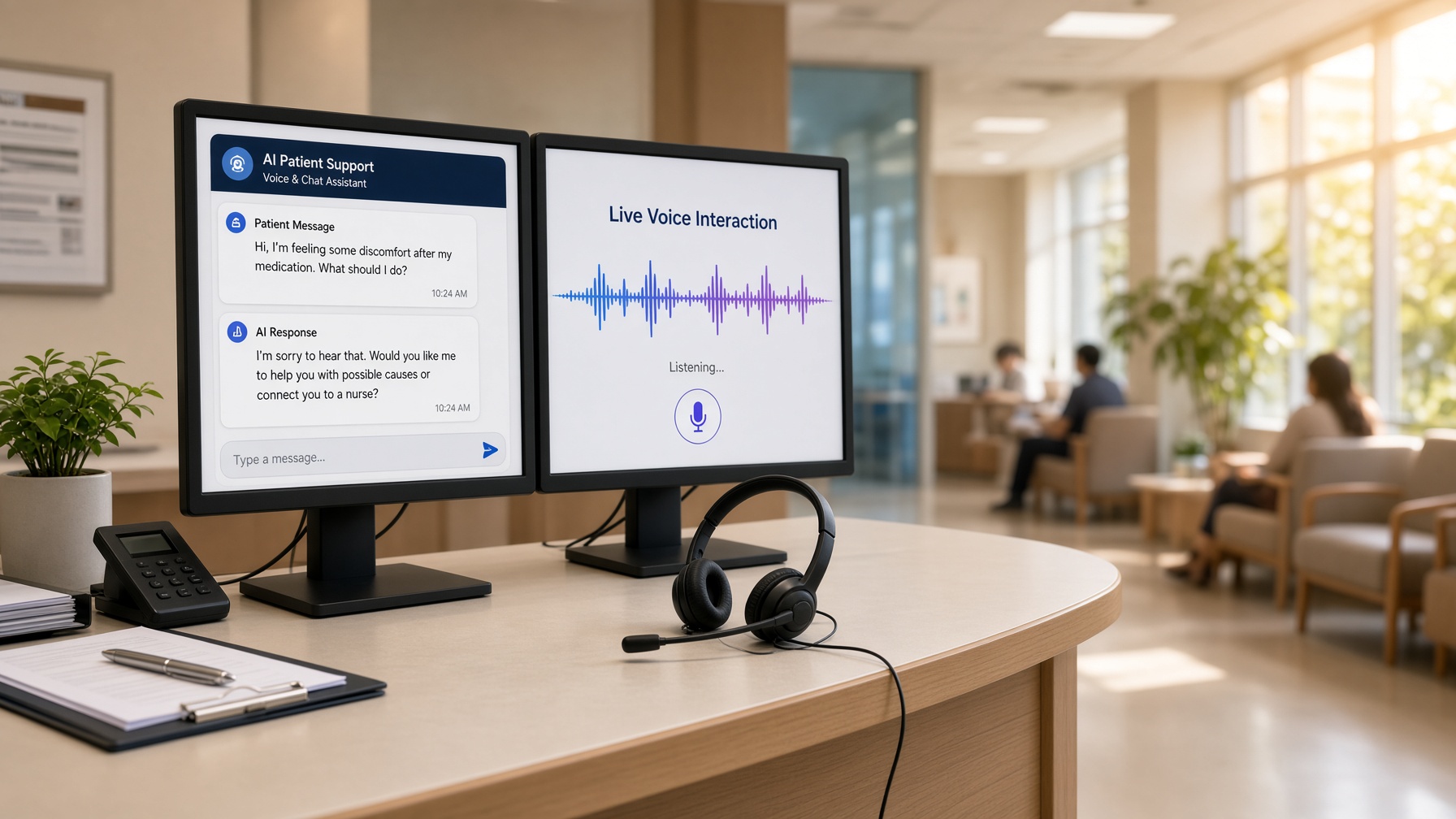
This is the highest-ROI first move for most private hospitals and multi-site groups. The intents are boring on purpose: hours, directions, prep instructions, appointment status, refill routing, “do I need urgent care.” Voice and chat both work. The design that survives contact with a real ward is a warm handoff — the model admits uncertainty and a nurse takes the call with the transcript already on screen.
- Baseline: average speed of answer, after-hours abandon rate, nurse overtime on the same five questions.
- Target: sub-minute first response, 50–70% of after-hours contacts resolved without a clinician, zero silent failures.
- Hard no: symptom checkers that imply a diagnosis on day one.
2. Scheduling, reminders, and no-shows
No-shows are a cash and capacity problem. Automation here is not a calendar widget. It is a conversation that confirms identity, offers real slots from the scheduling system, sends reminders on the channel the patient already uses (SMS, Viber, WhatsApp, Messenger), and lets them reschedule without waiting on hold.
In Philippine and ASEAN private hospitals, after-hours Messenger traffic is often more than a third of all inquiries. If your reply time is hours, you are leaking bookings to whoever answers first. A 14-day sprint can put a qualifier + booker in production on one specialty, then clone the pattern.
3. Clinical documentation (ambient and after-visit)
Doctors did not go to medical school to type. Ambient documentation — a draft note from the encounter, edited by the clinician — is the automation that returns hours per clinic session. The failure mode is a draft that is confidently wrong. Production systems show source snippets, mark uncertainty, and never auto-sign.
Start with a high-volume, relatively structured clinic (follow-up OPD, dialysis, oncology infusion) before you try the emergency department.
4. Prior authorization, claims, and medical records packets
Revenue-cycle teams drown in PDFs. Classification, extraction, and packet assembly are document-processing problems we already solve in finance — the hospital version adds coding rules and payer-specific checklists. A human still releases the claim. The model does the gathering.
Typical early win: turnaround on medical-records requests and first-pass yield on a single high-volume payer. Measure days in A/R, not “AI accuracy” in a vacuum.
5. Bed, discharge, and transfer coordination
This is a later move. The data is messier and the stakes are higher. When it works, an assistant watches census, flags delayed discharges, and drafts the next action for a bed manager. It does not move patients by itself.
What you should not automate first
- Triage that implies emergency vs. stay-home advice without a licensed protocol and an on-call clinician.
- Medication changes, lab interpretation, or image reads as a v1 product.
- Anything that writes to the EHR without an audit trail and a rollback.
- A “hospital Copilot” with no workflow attached. Tools without an owner become shelfware.
We design for the person who will live with the system on a Tuesday afternoon — not the slide that wins the RFP.— ABI Tech, operators-first principle
A 14-day hospital automation sprint
You do not need a 12-month transformation to learn if this works. You need one workflow, production data, and a nurse manager who will tell you when it is wrong.
- Days 1–2 — Discover: pull 90 days of call/chat intents. Pick one cluster (usually after-hours FAQs + booking). Name the baseline.
- Days 3–5 — Design: conversation map, escalation rules, EHR read/write list, PHI boundary. Legal and nursing sign the hard nos.
- Days 6–11 — Develop: connect the channel (voice or Messenger), the scheduling or ticketing system, evaluation set from real transcripts, human takeover.
- Days 12–14 — Deploy: limited hours or one site. Dashboard for containment, handoff, and safety flags. Hypercare with the ward, not the vendor Slack only.
That is the same Discover → Design → Develop → Deploy → Scale path we use across industries, tightened for clinical operations. Custom AI and automation & integration are the build; dedicated teams stay after go-live because models drift and clinics change their scripts.
PHI, vendors, and the EHR you already paid for
Do not extract a second patient database “for the AI.” Keep identities and clinical facts in the EHR or an approved data store. The automation layer should see the minimum it needs to complete the turn: slot availability, not the full chart; appointment status, not the problem list — unless the use case truly requires it and counsel has agreed.
Log every access. Prefer vendors who will sign a data-processing agreement, support residency requirements, and let you turn off training on your data. If a salesperson cannot answer where the audio goes, stop the meeting.
What to measure (and what to ignore)
Ignore vanity: number of “AI conversations,” model leaderboard scores, hours of training data. Watch the operations numbers finance already believes.
- Access: speed of answer, abandon rate, booking conversion from digital channels.
- Labor: after-hours nurse/agent minutes per contact, overtime on repetitive intents.
- Quality: handoff rate, reopen rate, complaints mentioning the bot, clinician edit distance on drafts.
- Revenue: no-show rate, days to complete a records request, first-pass claim yield.
If a metric cannot be read weekly by the COO without a data-science translator, it is not a production metric yet.
How ABI Tech runs this from Ortigas
We are an implementation firm, not a model shop. Hospital programs we take follow a fixed shape: a named workflow, a 14-day path to production or a clear no, and a team that stays after go-live. Clients sit in healthcare, finance, retail, and operations across APAC and beyond. Meetings are by appointment at One Corporate Center, Ortigas Center, Pasig — or on a video call if your ward is not in Metro Manila.
If you already bought Copilot, a voice vendor, or a chatbot that never left UAT, that is a rescue, not a greenfield. Bring the failed demo. We will tell you in one working session whether it is salvageable.
Questions we get from hospital teams
- What is AI automation in a hospital, in practice?
- It is software that completes a repeatable operational workflow — answering after-hours questions, booking, extracting a document, drafting a note — with a human taking over when the model is unsure. It is not a chatbot on the homepage.
- Will this replace nurses or doctors?
- No. The automations that work take clerical load off clinicians: refill status, scheduling, intake, and documentation. Clinical judgment stays with licensed staff.
- Do we have to replace our EHR?
- No. Production hospital AI sits on top of the system of record through approved interfaces. Rip-and-replace is how programs stall for two years.
- How do we handle PHI?
- Keep protected health information in the EHR and approved vendors. Log access, minimize what the model sees, and put a human in the loop for anything clinical or irreversible.
- How fast can a first workflow go live?
- A tightly scoped workflow — one channel, one intent cluster, warm handoff — can be in production in about 14 days if the EHR interface and a named operations owner already exist.
Put one hospital workflow into production
Talk with ABI Tech about after-hours support, scheduling, or document automation — 14 days to a live system, on top of the EHR you already have.